An English curriculum we build ourselves: how Mutamayyez maps every level to the CEFR
Short answer: Mutamayyez builds its own English curriculum in-house: 11 levels from Pre-A1 to C1.2, each tied to a band of the CEFR, the Council of Europe's framework for language ability [1]. Every level is made for one live, one-to-one, 25-minute lesson, and checked carefully before a single lesson is written.
Why we build our own English curriculum
Most English books are written for a class of 30 and a long lesson. Ours is a different moment: one learner, one teacher, 25 minutes, inside our app.
A plan made for a crowded room does not fit that moment. So we shape the curriculum around the learner, not the other way round.
Three things guide us. The CEFR is our map, so progress means something outside Mutamayyez too. The lessons feel close to home, written with Arab culture and values in mind. And it all grows from our team's own experience in education, led by our academic lead, one of the co-founders.
How our levels map to the CEFR
The CEFR has six main levels, A1 to C2 (read English levels A1 to C2 explained) [1]. In 2020 the Council of Europe added Pre-A1, "halfway to A1", and said its levels may be split to fit each context [2].
These are our own Mutamayyez levels, Level 1 to Level 11, and each one is mapped to a CEFR level (Level 1 is Pre-A1 and Level 11 is C1.2), so you always know where you stand internationally.
We split each band into two steps: Pre-A1, A1.1, A1.2, A2.1, A2.2, B1.1, B1.2, B2.1, B2.2, C1.1 and C1.2.
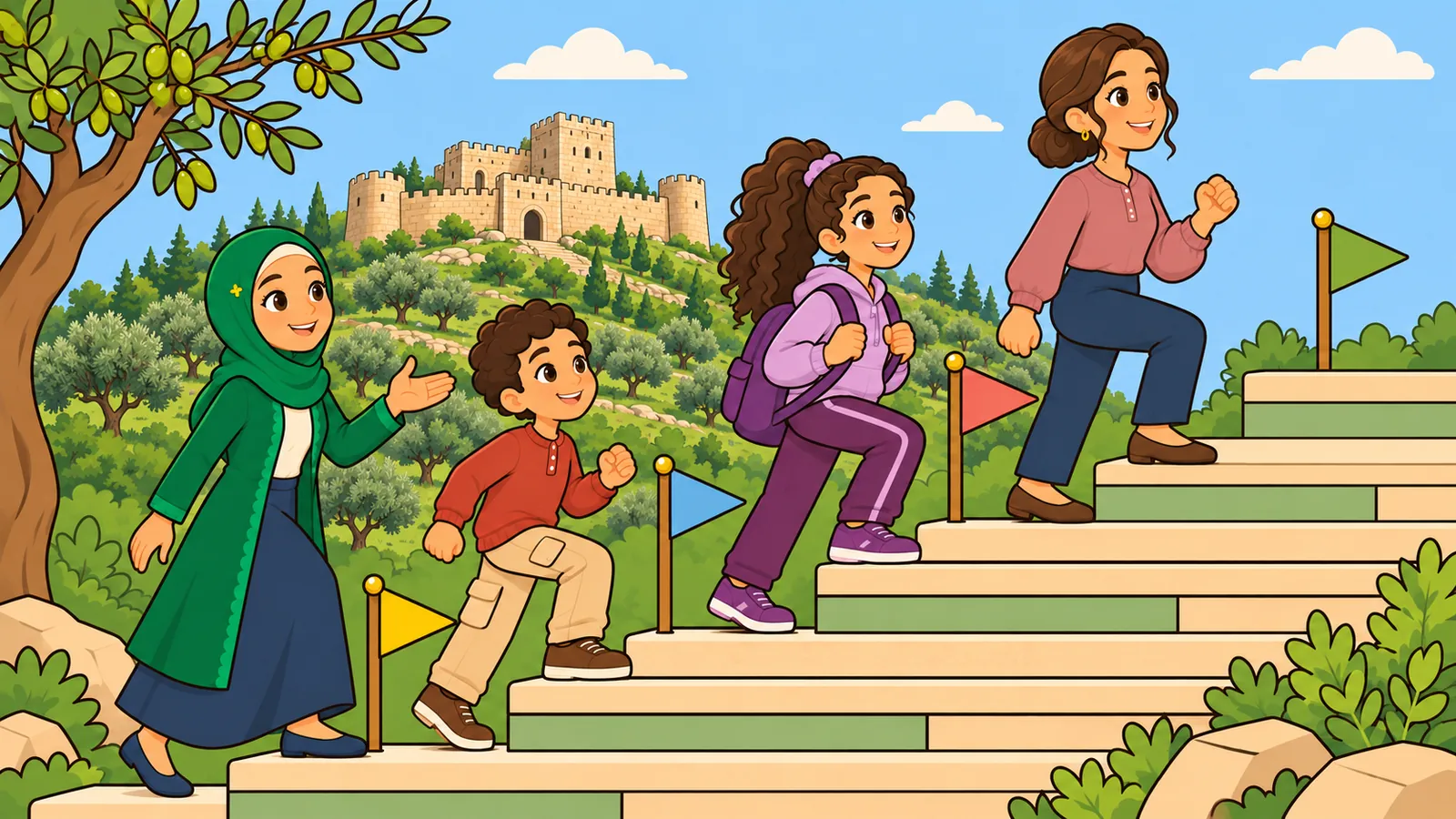
Why smaller steps? Because a learner who sees progress often keeps believing in themselves. Each new level is a small win to celebrate, for the learner and for the family watching them grow.
What goes into each level
Every level has the same clear building blocks:
- CEFR goals: what the learner can do by the end.
- A scope and sequence: topics, words and grammar in teaching order.
- A tracker: what was already taught, so new lessons bring it back.
- Level rules and a review checklist.
- A cast of characters the learner meets.
Checked before any lesson is written
A plan can look perfect on paper and still fail in a real 25-minute lesson. So every level is checked first: does it reach its CEFR band, do words come back often enough, do the four skills grow together, does each lesson fit 25 minutes, does it suit our learners, and does it follow on from the level before?
Bringing words back is on purpose. Memory research shows that practice spread over time is remembered longer than the same practice crammed together [3].
From the plan to the screen
A curriculum comes alive in the lesson. Ours are built in our own Lesson Studio, with animated characters and Mezo, our octopus mascot. See inside our interactive lessons, and meet the people who bring them to life in how we choose our teachers.
Find your starting level
Every learner starts with a level-test class with a teacher, then gets a personal study plan.
Frequently asked questions
Is the Mutamayyez curriculum based on the CEFR? Yes. It has 11 levels, from Pre-A1 to C1.2, and each one is tied to a band of the CEFR, the Council of Europe's framework for languages [1].
What is Pre-A1? The band the Council of Europe describes as "halfway to A1" [2]. It is our first level, for the youngest beginners.
Do you use a ready-made textbook? No. Our curriculum team designs the levels and lessons in-house, for live one-to-one 25-minute lessons, with our own characters and stories.
How do you know which level to start at? A level-test class with a teacher finds the level, then we prepare a personal study plan.
Sources
- Council of Europe. CEFR, Common Reference Levels: global scale. https://www.coe.int/en/web/common-european-framework-reference-languages/table-1-cefr-3.3-common-reference-levels-global-scale
- Council of Europe (2020). CEFR Companion volume, pp. 24 and 38. https://rm.coe.int/common-european-framework-of-reference-for-languages-learning-teaching/16809ea0d4
- Cepeda, N. J. et al. (2006). Distributed practice in verbal recall tasks. Psychological Bulletin, 132(3), 354–380. https://doi.org/10.1037/0033-2909.132.3.354
Mutamayyez is a Jordanian, Arab platform for learning English